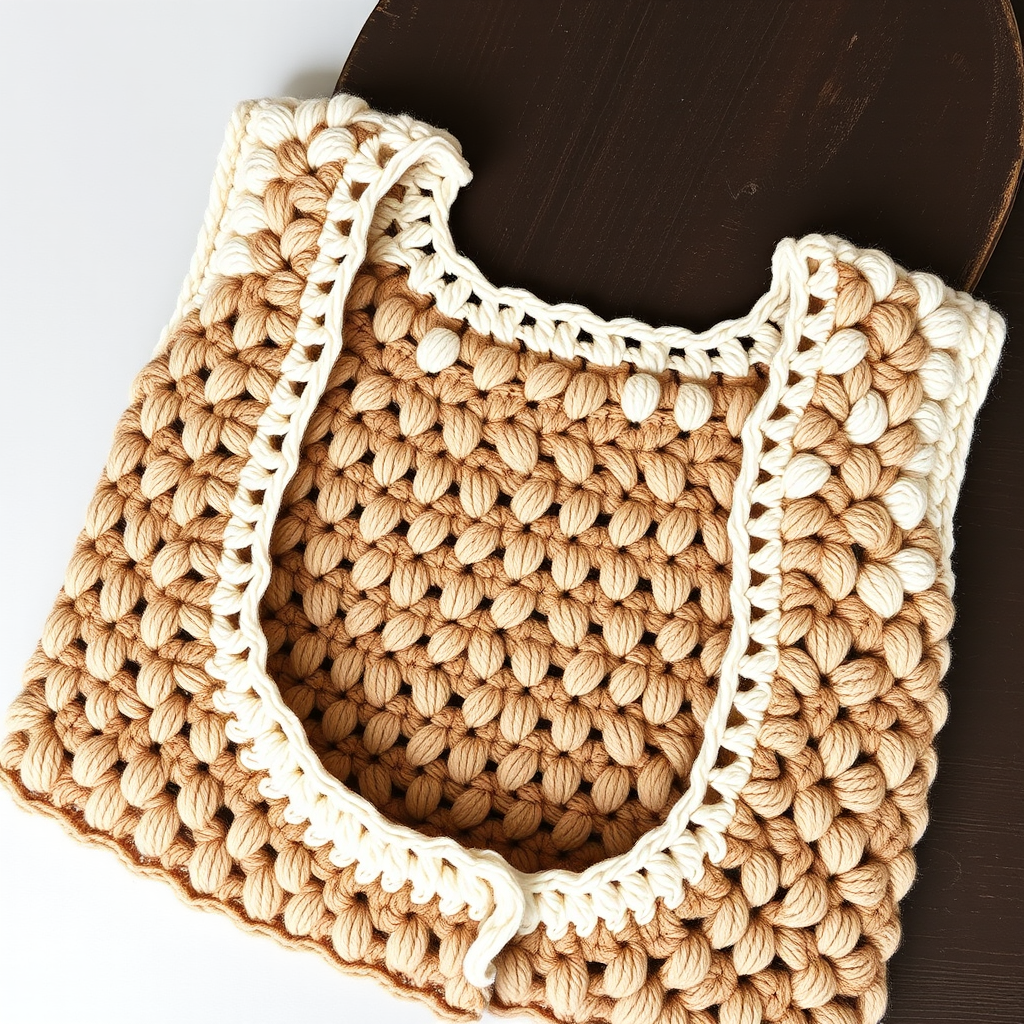
Petalpath Scallop Crochet Vest Free Pattern: A Fairycore Rose & Ivory Cover-Up

Petalpath Scallop Crochet Vest: A Fairycore Rose & Ivory Cover-Up
Introduction
If you have ever dreamed of wearing something that looks like it drifted out of a storybook garden, this is the project for you. The Petalpath Scallop Vest is a featherlight, front-open cover-up made from one simple rectangle of double crochet, then framed all the way around with rose pink petal fans and ivory scallops. It is perfect for complete beginners because the body is just one stitch, worked back and forth, with no shaping, no sleeves, and no complicated counting. The finished piece feels soft and airy, drapes gently over a sundress or slip top, and finishes with a delicate crocheted tie cord that you knot into a bow at the front. Think of it as a wearable flower petal: simple to make, magical to wear.
Materials Needed
- Yarn: DK weight (category 3) yarn, approximately 480 (540, 610, 680, 760) yards total. This breaks down as 400 (450, 510, 570, 640) yards ivory for the body and 80 (90, 100, 110, 120) yards rose pink for the scalloped petal edging and tie cords. The sample uses a smooth cotton-merino blend DK.
- Crochet hook: G/6 (4.0 mm), or the size needed to match gauge.
- Stitch markers: At least 4, to mark your first stitch, the corners, and the neck slit.
- Tapestry needle: A blunt-tipped needle with a large eye for weaving in ends.
- Scissors: Any sharp pair for cutting yarn.
- Measuring tape: For checking gauge and length.
- Spray bottle and pins: For blocking the finished vest.
- Finished size: XS (S, M, L, XL). Finished back width: 16 (18, 20, 22, 24) inches / 40.5 (45.5, 51, 56, 61) cm. Finished length from shoulder to hem: 20 (21, 22, 23, 24) inches / 51 (53.5, 56, 58.5, 61) cm. Designed with 2–4 inches / 5–10 cm of positive ease so the front edges meet or nearly meet when tied.
Abbreviations and Beginner Glossary
- ch – chain. Make a loop of yarn on your hook, wrap the yarn over the hook, and pull it through the loop. That is one chain.
- sc – single crochet. Insert your hook into the stitch, wrap yarn over, pull up a loop (2 loops on hook), wrap yarn over again, and pull through both loops. One loop remains.
- dc – double crochet. Wrap yarn over the hook, insert hook into the stitch, wrap yarn over, pull up a loop (3 loops on hook), wrap yarn over and pull through 2 loops, wrap yarn over and pull through the last 2 loops. One loop remains.
- sl st – slip stitch. Insert hook into the stitch, wrap yarn over, and pull it straight through both the stitch and the loop on your hook. It joins without adding height.
- st(s) – stitch(es). One completed loop or "V" in your fabric.
- sk – skip. Do not work into that stitch; move past it to the next one.
- sp – space. The small gap created by a chain, which you can work into.
- ch-1 sp – chain-1 space. The little hole made by one chain stitch.
- rep – repeat. Do the same instruction again.
- RS – right side. The front, public-facing side of your work.
- WS – wrong side. The back, hidden side of your work.
- Petal Shell – [dc, ch 1, dc, ch 1, dc] all worked into the same stitch or space. This makes one fan of three double crochets separated by chain-1 gaps.
- Petal fan – another name for one completed Petal Shell.
- Valley – the single stitch between two petal fans, where the scallops dip down.
- Turn – flip your work over so you can crochet back in the other direction.
- Fasten off – cut the yarn a few inches from your work and pull the tail through the last loop to lock it.
Gauge
10 dc x 5 rows = 2 inches (5 cm) in double crochet; 4 pattern repeats of the petal edging = 4 inches (10 cm).
Gauge matters because it decides whether your vest fits. If your stitches are bigger than the gauge, the vest will come out wider and longer; if smaller, it will be too snug. To make a swatch, chain 22, work double crochet in the 4th chain from the hook and in each chain across (20 dc), then work 8 more rows of dc. Lay it flat, measure a 2-inch section in the middle, and count the stitches and rows. If you have more than 10 stitches in 2 inches, go up a hook size; if fewer, go down. Always swatch before you begin.
Beginner Tips Before You Start
- Count every row. The body is one long rectangle, so a missed stitch at the edge will make the sides wavy. Count your stitches at the end of each row and place a stitch marker in the first and last stitch.
- Do not pull the yarn too tight. Keep your tension relaxed and even. Tight stitches make the fabric stiff and the scallops curl.
- Mark the neck slit. When you split the rectangle into two front panels, place a marker on each side of the center gap so you never accidentally work into it.
- Keep the edging count flexible. The scallop border needs a multiple of 4 plus 1 single crochets. If your count is off by one or two, work two single crochets together or add one at a corner — no one will ever see it.
- Work the edging in good light. The petal fans are quick but need a little attention; save them for when you are fresh.
- Block at the end. A light blocking opens the scallops and makes the whole vest look professionally finished.
Step-by-Step Instructions
Body (Worked Flat as One Rectangle)
With ivory, ch 81 (91, 101, 111, 121).
Row 1 (RS): Dc in the 4th ch from hook (the first 3 ch count as the first dc), dc in each ch across. Turn. (79 (89, 99, 109, 119) dc)
Row 2 (WS): Ch 3 (counts as first dc), dc in each st across. Turn. (79 (89, 99, 109, 119) dc)
Rows 3–45 (3–48, 3–50, 3–53, 3–55): Repeat Row 2 until the piece measures 18 (19, 20, 21, 22) inches / 45.5 (48, 51, 53.5, 56) cm from the foundation chain, ending after a WS row. Do not fasten off. (79 (89, 99, 109, 119) dc)
Neck Slit and Shoulder Division
The next rows split the rectangle into two front panels with a center opening.
Row A (RS): Ch 3, dc in the next 34 (39, 44, 49, 54) sts (first front panel). Turn, leaving the remaining sts unworked. (35 (40, 45, 50, 55) dc)
Rows B–E (B–E, B–E, B–F, B–F): Ch 3, dc in each st across. Turn. Work even in dc on these 35 (40, 45, 50, 55) sts for 2 (2, 2, 3, 3) more inches / 5 (5, 5, 7.5, 7.5) cm, ending after a WS row. Fasten off.
Second front panel: Rejoin ivory with a sl st to the center st (the stitch immediately after the last st of the first panel), ch 3, dc in each remaining st across. (35 (40, 45, 50, 55) dc) Work even in dc for the same number of rows as the first panel. Fasten off. The unworked center gap between the panels forms the neck slit.
Scalloped Petal Edging (Rose Pink and Ivory, Worked Around the Entire Perimeter)
Round 1 (RS, rose pink): Join rose pink at the bottom right corner of the vest. Work sc evenly around the entire outer edge: 1 sc in each row-end along the right front edge, 1 sc in each st along the bottom hem, 1 sc in each row-end along the left front edge, 1 sc in each st along the left shoulder, 1 sc in each st along the neck slit edge, 1 sc in each st along the right shoulder, and 1 sc in each st along the right front edge back to the start. Join with a sl st to the first sc. Keep the total sc count a multiple of 4 plus 1; adjust by working 2 sc together or adding 1 sc at a corner if needed.
Round 2 (WS, rose pink): Ch 3 (counts as first dc), turn, [dc, ch 1, dc, ch 1, dc] in the first sc (petal fan made), *sk 3 sc, work a Petal Shell in the next sc; rep from * around, ending with a Petal Shell in the last sc. Join with a sl st to the top of the beginning ch-3. Fasten off rose pink.
Round 3 (RS, ivory): Join ivory with a sl st in the first ch-1 sp of the first petal fan. Ch 1, *work 5 sc in the center ch-1 sp of the next petal fan, sc in the next valley st between fans; rep from * around, working 5 sc in each petal fan center and 1 sc in each valley, join with a sl st to the first sc. Fasten off ivory and weave in ends. This round converts each petal fan into a rounded scallop, giving the vest its petalpath border.
Tie Cord (Rose Pink)
With rose pink, ch 60 (65, 70, 75, 80). Sl st in the 2nd ch from hook and in each ch across. Fasten off, leaving a 4-inch tail. Make a second identical cord. Thread one cord through the front edge stitches at waist height on each side (or use a single long cord doubled and tied at center front). Tie in a soft bow at center front.
Assembly and Finishing
Seaming: This vest has no side or shoulder seams — the body is one continuous rectangle, so there is nothing to sew. Simply check that both front panels are the same length and that the neck slit sits centered.
Weaving in ends: Thread each yarn tail onto your tapestry needle and weave it back and forth through the wrong side of the fabric for about 2 inches, then trim close to the work. Do this for every color change and fasten-off point.
Blocking: Lay the vest flat on a towel or blocking mat. Pin each petal scallop open and flat, mist lightly with water, and let it dry completely. This opens the scallops and evens out the double crochet body.
Wearing: The vest is worn open or tied at the front with the cord. Thread the cord through the front edge stitches at waist height on each side, or use one long cord doubled and tied in a bow at center front.
Pro Tips and Variations
- Color play: Swap the rose pink edging for lavender, sage, or butter yellow for a different fairycore mood. You can also work the body in a soft pastel and the edging in ivory for a reversed look.
- Size adjustments: To make the vest wider or narrower, add or remove chains in multiples of 10 at the foundation. To make it longer, add rows to the body before the neck slit; to shorten it, work fewer rows.
- Yarn substitution: Any DK weight yarn works. A cotton blend gives crisp scallops; a merino blend gives a softer drape. Always swatch again if you change yarn, because gauge can shift.
- Extra petal detail: Add a second row of petal fans in ivory along the bottom hem only, or work the tie cord in a contrasting color for a little pop at the waist.